
The One Portrait Every Family Should Take Before a Grandparent Passes

The families who come to me with the most emotion in their voices are rarely the ones with a new baby or a child heading off to college.
They’re the ones who just lost someone.
Not always immediately after — sometimes it’s months later, sometimes years. But they come in, and they sit down, and they tell me about their grandmother or their grandfather, and at some point they say some version of the same thing: “We never got a real portrait of her. I don’t have a single good photo of him in the last fifteen years.”
I’ve heard this more times than I can count. And every time, I think the same thing: this was preventable.
The Portrait You Think You’ll Get Around To
I understand why it doesn’t happen. It never feels urgent. Grandparents are still here, still sharp, still coming to Thanksgiving. There’s always next year, always another occasion.
But I’ve photographed families in the Twin Cities for over forty years, and I’ve watched how quickly the window closes. Health changes faster than we expect. Mobility changes. Energy changes. And then one day, the person is gone, and what you have is a collection of phone photos taken at holidays — usually blurry, usually unflattering, usually with someone’s arm in the frame.
That becomes the photographic record of one of the most important people in your life.
This is not a small thing. A photograph is how the people who never met your grandmother will know what she looked like. How your grandchildren will picture her when they hear the stories. A phone snapshot from Thanksgiving isn’t going to carry that weight. A real portrait will.
What Most Families Wait For
In my experience, families wait for one of two things: a major event or a health scare.
They think: we’ll do it when everyone’s together for the reunion. We’ll do it for mom and dad’s fiftieth anniversary. We’ll wait until after grandpa’s surgery and he’s feeling better.
The problem is that major events are logistically complicated — people fly in from out of state, schedules are tight, the grandparent is exhausted by the time a portrait session comes up, if it comes up at all. And after a health scare, the moment has already changed. The portrait you could have made a year ago, when your grandfather was fully himself, is a different portrait than the one you can make now.
I’m not saying don’t wait for events. I’m saying don’t wait only for events. A portrait session doesn’t require a milestone.
What the Portrait Should Actually Be
I want to address something I hear occasionally: “He would never sit for a portrait. She doesn’t like having her picture taken.”
I’ve heard this about people who ended up being the most natural subjects I’ve ever photographed. What people resist isn’t being photographed — it’s the idea of being photographed. They’re imagining something formal and uncomfortable, a session that makes them feel like they’re posing.
A good portrait session isn’t that.
As a portrait photographer in Edina MN, I’m after is the person as they actually are. The way they hold themselves when they’re at ease. The expression that comes through when they’re telling a story. These are things I’ve spent forty years learning how to draw out. It’s quiet work. It’s unhurried. And almost everyone who comes in skeptical leaves having genuinely enjoyed it.
The portraits that endure are the ones where the person looks like themselves. Not like someone who’s being photographed — like someone who’s living.
The Multi-Generation Portrait
If there’s one portrait I could talk every family into making, it’s this one.
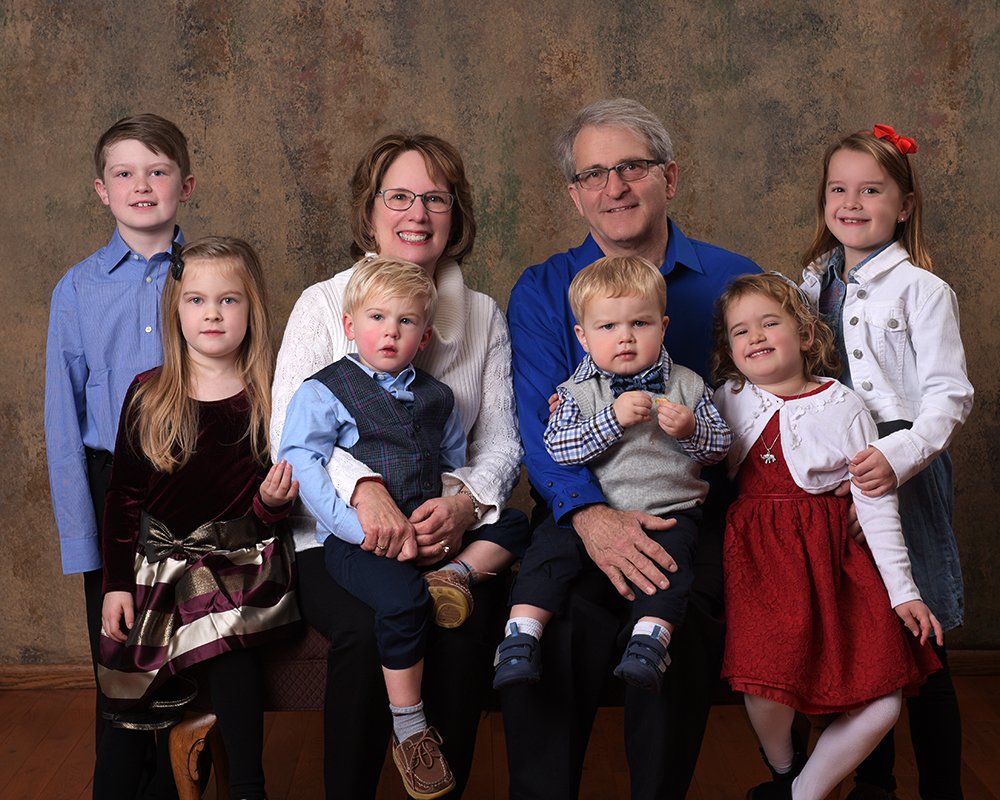
Three or four generations in a single frame. Great-grandparent, grandparent, parent, grandchild. All in one room, all lit properly, all actually looking at the camera at the same time.
These are the portraits I see framed in living rooms twenty years later. The ones families show me when they come in for a restoration of something much older and say, “I want to make sure this never needs to be restored.” They’re the ones that get passed down.
There is a window for this portrait. It’s not infinite. And unlike most things in life, it closes without warning.
If you have a grandparent still living — especially one in their seventies, eighties, or beyond — I’d ask you to consider making this portrait now, not at the next family reunion, not after the holidays, but soon.
What to Do With It Once You Have It
A portrait like this deserves to be printed. I mean that specifically — not stored on a hard drive, not living in a cloud folder, but printed and framed.
I’ve written about why printed vs. digital photo legacy matters, but for this kind of portrait, the reasoning is even simpler. The people in the photo won’t always be here. The print will be. And a print on the wall is seen every day — it stays in the family’s consciousness in a way that a file on a phone simply doesn’t.
When I make a portrait like this at Dale Studios, I think about how it will look on a wall in forty years. That’s the standard I’m working to.
This is also the right moment to connect the portrait to the broader photo legacy you’re building for your family — to make it part of a deliberate, multigenerational record rather than a single isolated image.
The Conversation You Have Afterward
There’s something that often happens after a portrait session with an older family member.
The session itself breaks the ice. Suddenly everyone is in the same room, the pressure is off, and conversation opens up in a way it doesn’t always at holidays. I’ve seen grandparents start telling stories they hadn’t told in years. I’ve seen grown children hearing things about their parents’ lives for the first time.
That’s worth something. The portrait gets you in the room together. What happens in that room is yours.
If you’re thinking about a multi-generation portrait and you’re not sure where to start, give us a call. I’d be glad to talk through what a session like this looks like. You can also read about building a generational portrait tradition that your family will continue long after any one session is finished.
Related Reading
- The Photos Your Grandchildren Will Never See
- Creating a Generational Portrait Tradition That Lasts 100 Years
- Photo Legacy
The session itself is the easy part. The hard part is deciding it’s time. If you’re reading this, you’ve probably already decided. You can reach us at (952) 400-1020. We’re in Eden Prairie and we’ve been doing this since 1983.